A True Doctor Has Several Women
“A real doctor has several wives” – I heard this sentence from a patient during one of my visits to Zagreb. I was working weekends, primarily to help the Breast Cancer Association in Zagreb (Seva program). The phrase “Seva program” originates from the Sanskrit word seva, meaning “selfless service” performed without anticipation of reward.
A biomedical specialist, a Western doctor medicine specialist who had specialized in London, kindly made his premises available to me for my visits and work in Zagreb.
While talking to a client in office, someone knocked on the door within the first five minutes. As usual, I had a therapy schedule for the members Breast Cancer Association. I wondered who it could be, since I was with a client who had just started a one-hour session-therphy. I walked to the door, and opened it.
There stood a woman who actually had a later session-theraphy – she was holding a Large Book. She asked me if the doctor (a biomedical specialist, a Western doctor medicine specialist – who had given me the room was here.
I replied that it would be here on Monday! She gave me a book – I don’t remember if she said it was a gift for him or if she had received it from him and was returning it – and then in a “second” she uttered the sentence that I chose for the title of this blog – “A real doctor has several wives!”
We said goodbye, I closed the door, put the book on the table and continued with my purpose in the office. Since I could have up to 15 clients a day, about 30 over two days, it didn’t occur to me to think about it further, nor did I think that my thoughts, the book and the encounter with the woman at the door carried some deeper message – “A real doctor has several wives!”
As I write this Blog, I am overwhelmed by memories and feelings from my youth. Later, sometime in my youth until my thirties, most people told me that I was handsome, intelligent, and so on, and that I probably had many wives. This became a kind of slogan that essentially created a burdensome energy in my life.
However, over time, I consciously came to terms with such opinions about my life and with the thought that I should have many wives, thanks to the fact that God and Karma intended for me to get married and later create a family life with two children. In order to fully understand this blog, especially for those who do not know me personally or physically, either from my youth or from these later years, it is important to understand the background.
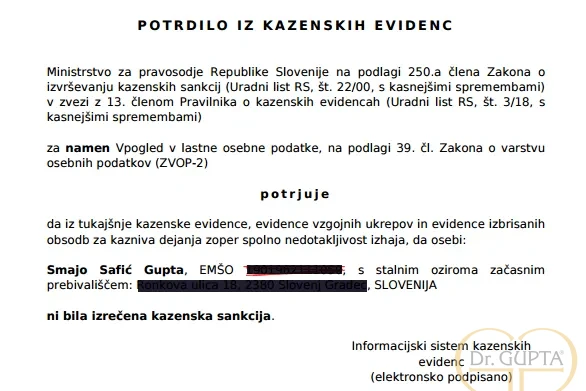
My blog also contains a photographic document related to the Slovenian language, and legal documentation related to the country in which you live and work. You can also make your own translations. Before I present the document, I would like to clarify that the writing of this blog is also based on the fact that I appeared in court twice.
- First, I received a subpoena from one of my students. Through my teaching and group work, she began to see me as her “closest husband – love, someone with whom she imagined sharing home, work and joy in life”.
- The second time, I received another summons to give a statement in court, again involving a woman – actually, a patient. Her husband had reported me to the court, claiming that I had deceived or wronged “his wife,” and so forth.
Since I live in Slovenia, a very small country of approximately two million people, anyone can easily become a “star,” a “thief,” or something else entirely in the eyes of others. It depends on how you accept things and how others want to see you through the lens of their own Ego.
At the same time, you should understand that the “first and second women” in my examples had very close connections with people involved in politics and the judiciary. Therefore, I could already be “punished”, not only for appearing in court – for existence, name and surname and professional work, which was not Slovenian and therefore created “a different image – worse, compared to others”.
Personal and political connections between judges and politicians, particularly people close to politics and state institutions, can create doubts about the impartiality of judicial decisions in sensitive cases. On the other hand, media both newspaper and online media outlets close to such circles had to write extensively about me, portraying me as everything imaginable – as if I were neither a doctor nor a “human being,” but simply a nobody, even a thief, merely to defame me in that small Slovenia.
- But there is God, and only God sees the good within a person.
I believe and feel that God freed me through true justice “With Him,” just as in court – and that this photographic document in this blog officially confirms that. And God forbid that when I mention God, it should be understood merely as a defense that I am a completely honest and good person while others are not.
In fact, when a friend and I visited a monastery in Serbia and I was lighting candles, he noticed that I had placed many candles for prayer. In his eyes and thoughts, he wondered how many relatives I had. He knew my family and why I was lighting the candles. I told him that the first and second candles were dedicated to the two women I describe and think about here.
- May God help them and their families on their life journeys. May they live well and have the very best in Life.
I could write entire novels about these events, but both court proceedings lasted approximately five years, if not longer. In any case, I do not return to the past. I always think and work with what exists today and what lies in the near future – through my thoughts and actions.
It should be noted that the two women who are the subject of this blog knew each other through me. One worked with me as a therapist, while the other was a patient. Naturally, both showed a certain affection toward me as “the closest possible warm person” in their lives.
During that period, and even beforehand, I wrote emails to them in an attempt to change the energy they directed toward me and toward themselves. I also presented my written intentions in court. One sentence from those writings remains particularly dear to me. I wrote it to a woman who was married:
- “I am now your bridge of love, which you must cross together. Because of this, you will become even better in your love. But first, “you as a woman, and he as a man” should stop for a while on that bridge and talk about the state of your love.
- The only bridge in a long-distance relationship is “communication”. It’s the most vital cord that enables both partners to call it a relationship in the first place. If love showing up without fail, listening without judging, and dedicating every bit of my existence to understanding you, then state of love is absolute, steady, and endless. You can stay in this place-bridge for as long as necessary.
For many people who have not developed warmth through their family, particularly through a partnership, encountering something they have been missing can deeply affect them. They begin to “absorb it quickly,” receiving something they have long lacked.
Warmth and affection can strongly attract people who have been deprived of attention, but they can also confuse them because closeness is unfamiliar to them. People who rarely experience warmth may become excessively attached to the person who provides it. It is therefore very important to recognize and maintain healthy boundaries in every relationship and every encounter.
People – especially women – who lack awareness of existence (and love is itself a form of existence in this life) can become possessive and jealously fight to possess what they believe they should have.
In fact, this was the beginning of my “fated-karmic encounters” with the courts in this life. Especially when at some point I had to say and show STOP to these women and such possessive energy. I have a warm mission: to help people holistically. In this mission, ethically speaking, I never intended to have a woman or more women with my work.
My Karma and the status that my work gives me provide me with a great deal of warmth, which I can then give to others every day, regardless of their social position, status, or circumstances. Especially to those who do not have warmth within themselves, or who never received it or became conscious of it.
Because my existence, as well as my the therapeutic work of a doctor – must always be aimed at reaching people in this way. When I was planning to write this blog, I thought deeply about the meeting in Zagreb with a woman who came to my door, gave me a book and uttered the sentence that I chose for the title – “A real doctor has several wives”.
Through meditation on this event, I know exactly what she meant: the warmth she experienced in the therapeutic work of a doctor. In reality, warmth and such feelings are difficult to describe, as they represent the deepest form of personal intimacy. They cannot be calculated, earned, given or received in the usual sense. They simply exist within a person. When that warmth loses its purpose – or when you think about and translate it into my experience of appearing in court – it becomes Karma:
- I must live through such a life regardless of the outcome, whether I am right or wrong.
True warmth in the Soul is essentially the result of truthfulness within a person, and it always reveals its qualities precisely during difficult karmic events. Keep in mind that a warm and calming doctor can help reduce a patient’s anxiety, build trust, and improve overall health outcomes. A doctor’s calm and friendly approach helps patients feel safe during stressful medical examinations.
Open communication builds trust and encourages patients to share accurate and complete information about their health. Patients are more likely to follow treatment plans when they feel supported and encouraged rather than judged. The key features of supportive communication are always built through active listening, particularly by recognizing a patient’s fears or pain in greater detail.
A doctor must be clear about their beliefs, explain medical terminology in simple language, and offer realistic hope. Patients should often be praised, especially for the small steps they take toward healthier habits.
A doctor must also be able to see the patient’s vulnerability. Patients often come to doctors during periods of illness, fear, and heightened emotional sensitivity. The doctor is in a position of authority – someone who provides help, protection, and security. The warmth, compassion, and active listening provided by a doctor can sometimes be misinterpreted as personal or romantic attraction.
Professional and ethical boundaries must first be maintained by the doctor, regardless of the “energy” expressed by the patient. Any form of romantic or sexual relationship between a doctor and a patient is incompatible with good therapeutic practice or a healthy mutual life relationship.
If someone reading this blog works in a similar way to me, please remember that romantic feelings can impair a doctor’s objectivity and potentially compromise the quality of treatment and sound medical decision-making. It is important to document such situations in the medical record to protect both parties. If a client’s feelings interfere with the therapeutic process, the safest and most appropriate option is to transfer the patient to another doctor.
Every time we choose silence – when we do not speak, when we are not loud or visible – in the face of injustice, when we turn our eyes away from “justice and injustice” and say or think, “It does not concern me,” we betray something sacred within ourselves.
It is a deep betrayal of our existence and a deprivation of our most authentic dignity. It is good to do what is right even when expressing our true position is inconvenient or uncomfortable at that moment. Regardless of how much it costs us, whether financially or through some other form of material energy.
By choosing to act according to a righteous conscience, we claim our most authentic humanity. In the presence of injustice, we bring the light of justice into our hearts – the most valuable and brightest light of all. Since I have lived with and practiced Buddhism for the past 30 years, I will briefly describe the Three Dharma Seals, fundamental principles used in Buddhism to affirm the Buddha’s essential teaching.
Dukkha
- Life cannot provide lasting satisfaction through the material world because everything is impermanent. Suffering inevitably follows when there is no transformation in our actions and, especially, in our thoughts. Everything in the universe is constantly changing. Nothing lasts forever; nothing remains fixed or exactly the same.
Anicca
- Nothing is permanent, especially if we do not consciously recognize the constant changes that influence every experience. Cause and effect continually adapt and interact with one another. Therefore, a person can never achieve absolute clarity and permanence. All phenomena lack a permanent, isolated, or independent “self.” Everything exists interdependently in relation to everything else.
Anatta
- The private self – the Ego – is unreliable and ultimately unreal if we do not work and think positively every day. We use words such as “soul” and “personality” to name aspects of ourselves every day and even more frequently. Yet when something is beyond our understanding and unclear, we often seek something that can help us make sense of it. We never stop trying to make ourselves real, yet we may never fully succeed because our perception of ourselves can be unreal. Therefore, we seek comfort in illusion.
Everything that stands before us is reality. The final state is one of liberation, peace, and the cessation of suffering, achieved through the extinguishing of delusion and attachment. Imagine a seal stamped onto an official document. If a spiritual or philosophical teaching corresponds with these three truths, it carries the “seal of approval” of authentic Buddhist wisdom. If it contradicts them, it cannot be considered genuine Dharma.
The word Dharma refers to a principle of living and acting in accordance with cosmic order, duty, morality, and truth, a concept found in Indian religious traditions such as Hinduism and Buddhism. Emotionally, it can be comforting to believe that if we see someone as a good human being, they will not hurt us.
But this can also become a dangerous illusion if we do not feel goodness coming from others or if we do not feel that we ourselves are good people. When a person becomes conscious of pain and suffering, including the potentially frightening and long-term consequences of the cruelty of others and its effects on physical and mental health, they should “listen to their Soul” so that it can help them develop courage, resilience, and creativity – for a better tomorrow.
The idea that we must suffer in order to progress is questionable. We must also ask ourselves whether we carry cruelty within us—a willingness to abuse power through identity and selfish Ego, believing that “we are better than others.”
To be good human beings on this planet, Buddhism offers an alternative: the teaching and practice of Sadhana, through meditation and prayer, including what may be called wrathful compassion – acting out of love in order to stand against others when necessary, so that they may be protected from their own greed, hatred, and fear.
People – and animals and plants – do not exist merely to have a better or more meaningful life. They exist on their own terms because they have that right. However, whether we will learn something from their rights and existence is our own responsibility. Every person who approaches us is our teacher.
Someone brings out the best in us, while someone else may bring out the worst. And the opposite is also true: we can give that same kind of emotional and physical energy to others. Never forget that Karma reflects the principle that our intentional good actions shape our character and naturally encourage goodness within ourselves and in the world around us.
When I teach students, I tell them that Karma is the school of life. And every school must give us an opportunity to receive and earn a grade—a way to understand everything that is good in coexistence with others. When we receive the lowest grade, it is a sign—a moment when we must work harder to gain the knowledge and pass the examination that allows us to live more peacefully, better, more safely, and with greater joy.
Sharing life with others deeply increases our capacity for joy and helps us appreciate the present moment. Joy is earned and multiplied when we celebrate or experience moments together with others. Empathy and support are part of our awareness that we are not alone in this life, and they make it easier for us to endure everyday challenges. Conscious presence in life and appreciation of the people around us naturally ground us in the “here and now.”
Some Final Thoughts
This may sound morbid, but one fact we all have to face is that we begin our journey toward death the day we are born. Death is the end of dying, not the end of living. All our success and achievements may ultimately feel meaningless unless we accept God’s invitation to give our lives to Him.
It may not seem like much to others, but I am grateful for everything God has provided for me throughout my life. Now, I strive to continue developing my character and hope to learn, relearn, and master whatever I need to become the best person I can be.
I hope that, in my own way, I can repay God for all He has done for me by making the most of the life He has given me and developing the best character I can during my Earthly journey.
Let’s not forget! The Purpose of the Soul and the Journey Beyond Life! Every soul is born with a specific purpose or duty.
Desires are distractions that accompany us throughout our lives here on Earth. When we die, we come to understand whether the purpose or duty we were given for THIS life has been fulfilled. If it has not, we may choose to return while our body is still intact. But if the body has been destroyed, we must be born again with the same purpose or duty, making the previous life an incomplete attempt.
On the other hand, our desires determine whether we move forward or become a spirit. If we become a spirit, we may be unable to move on or be reborn for hundreds or even thousands of years. Being a spirit can be like hell for us because we still have desires, but we no longer have a body through which we can fulfill them or act upon them.
In Hinduism and Buddhism, the final rites are intended to help the soul of the deceased move onward rather than remain here as a spirit. Everyone who knew the deceased is encouraged to attend these final rites, in case the soul wishes to see a particular person one last time before saying goodbye to this world.
Hindus have also developed a way of determining whether all the desires of the deceased soul have been fulfilled. After performing certain rituals for the soul, an offering is prepared and placed outside, and a crow is expected to eat it. It is believed that crows are connected with the souls of the deceased and that, when specific rituals are performed using the name and lineage of the deceased, the soul may influence the crow’s behavior.
Shani is the divine personification of the planet Saturn in Hinduism, and is one of the nine heavenly objects (Navagraha) in Hindu astrology. Shani is also a male Hindu deity in the Puranas, whose iconography consists of a figure with a dark complexion carrying a sword or Danda (sceptre) and sitting on a buffalo or sometimes on a CROW.
He is the God of Karma, time and retribution, and delivers results depending upon one’s thoughts, speech, and deeds. Shani is married to the daughter of Gandharva Chitraratha, who cursed him that anyone he gazed upon would face destruction or hardship.
During certain rituals, the soul is invited to accept the offering if it has accepted the end of this life and is ready to move forward. If there are unfulfilled desires, the soul does not accept the offering, and no crow will touch it, even if there are hundreds of hungry crows in the area.
However, as soon as the person whom the soul wished to see one last time arrives – or if someone openly promises to care for the deceased’s son, take responsibility for arranging the marriage of his or her daughter, or care for his or her father or sick parents – the Crow is believed to come down and eat the offering.
But if no one can remember an unfulfilled desire that could be completed on behalf of the deceased soul, the offering may remain untouched for days and eventually has to be removed so that the area can be kept clean.
This is why, throughout our lives, we are taught that life here is an illusion and that we should not hold on to desires at the moment of death. Once the soul moves onward, it may choose to be reborn for a new lesson or duty, or in order to fulfill its Karma.
Liberation from the cycle of rebirth is considered a profound achievement and requires great effort, learning, and spiritual growth. It is as though our soul is engaged in a continuous process of learning. Most of this learning takes place on the level of the soul, but some forms of learning require the experience and interplay of emotions, and that is why we are born into physical life.
Many of us on this planet are born in a group – a family.
Some people make our lives easier, others make them harder, but we can see all of this as part of our learning for that particular segment of our lives. In the same lifetime, we also play a role in the lives of others – sometimes we help them, sometimes we make their path more difficult. This too is part of THEIR learning and part of OUR learning.
After we have completed all of our learning – not simply individual lessons, but the deeper learning accumulated over many lifetimes – we may hope to attain Nirvana, liberation from the cycle of rebirth.
And liberation from the cycle of rebirth does not necessarily mean that you will never be born again. It means that you are free to choose whether you wish to be reborn and, if so, when, in which family, what work will I do… study… You may still choose to return through another lifetime – not because you are bound to the cycle, but because you wish to help others on their journey.
Understand that the abundance of the universe is available to everyone, Prof. dr. Smajo Safić Gupta
11. September 2026

21. August 2026
27. July 2026